So, who really is David Gill?

David Gill pursues his love of painting whenever time permits.
In October 2025 the Mornington Peninsula Shire Council voted to request the Municipal Association of Victoria (MAV) board advocate for a 12-year cap on how long councillors can stay on the job over a lifetime. Right from the moment the change was proposed, it was clear that, if successful, the move would impact Councillor David Gill.
With 20 years clocked up, he is the longest serving member of the current council, and the one who represents us there. His “electorate”, the Coolart ward, that includes Shoreham, takes in a staggering 60% of the Peninsula.
State and Federal politicians are not subject to any such cap. And the council’s ambition has copped flak from some former councillors. It’s also a long shot.
Once the mayor, Cr Anthony Marsh, writes to the MAV recommending a cap on how long councillors can serve, the association would have to agree and, if it did, the change would still need to be signed off by the state government.
But it puts the spotlight on David Gill, who often plays a critical role in making decisions that directly affect our households and the wildlife around us.
The SCA caught up with him over coffee to learn more about the man: where he comes from and what makes him tick.
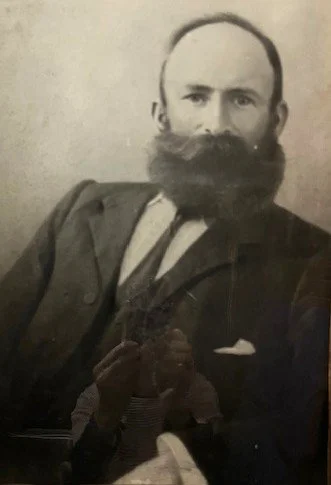
David Gill’s great-great grandfather James Gill (1835-1913) who came on the ship from Ireland with his mother Jane.
“I come from three generations on the Mornington Peninsula,” David says. “But further back my family came from Strokestown, County Roscommon Ireland, famous for being the centre of the Irish potato famine. There’s an independent and tenacious streak that runs through it. I like to think I have some of that.”
David’s great-great-great-grandmother, Jane Gill, nee Brown, left Ireland when her husband Bernard Gill died in the potato famine. A widow with three children including an eight-year-old and a baby, she needed to find her husband’s brother as, in those days, marrying another Gill secured her and her family’s name and future. She knew he had taken off for goldfields abroad, but had no idea whether they were in Australia or America. She took a chance and boarded a ship to Melbourne.
Shipping companies diverted Chinese migrants to ports other than Melbourne to avoid poll taxes and restrictions. Caught up in this, Jane disembarked at Robe and, baby in wheelbarrow, walked to the Ballarat goldfields. She found the brother and married him.
But life didn’t get easier for the ensuing generations.
David’s great-grandfather, Peter Francis Gill, was a soldier settler who had been granted 10 acres of barely arable land in Bowenvale near Maryborough after World War 1. Nine acres were riddled with mineshafts.
The councillor’s father, Ted Gill, and grandfather, Joe Gill, were greenkeepers and owned a golf club called Peninsula Links. You could phone Joe on Mt Eliza exchange 302, according to the scorecard that David has kept. When the course lost some fairways upon the expansion of the newly bituminised Nepean Highway and with the intended creation of what is now Peninsula Grammar, they gave up the 99-year lease. Ted became a chef and Joe a professional fisherman.
David was born in the Bush Nursing Hospital in Mornington, a three-bedroom brick cottage that remains as part of the Bays Hospital.
He grew up rabbiting, sometimes crawling underneath houses to pull out shot feral cats. By 17, he had left school and home, and found work as a kitchen hand, a hospital orderly – anything to pay the rent.
Later David enrolled in Macleod night school near Melbourne and started his matriculation (Year 12). He had a full-time job, and only attended the one weekly lesson for science “prac”. Everything else he learned from text books.
He was accepted into Law at Melbourne University and studied while working from 11pm to 6am as a night watchman, five nights a week. But with no connections in the legal profession David realised that securing Articles would be very difficult so he transferred to Arts, majoring in fine arts. He worked as an art teacher, an occupation he thoroughly enjoyed. He retired 19 years ago.
David was first elected to Mornington Shire Council from 1980 to 1990, when he took a break from public life before successfully standing for election again in 2016.
“My belief is always be transparent, hold Council accountable and treat every issue on its merits,” he says. “Political independence is critical when it comes to making local decisions. Everything involves politics, but in local government the politics is about enhancing how people live, not party politics; it’s local.”
David is proud to have played a part in many decisions about issues including protecting the green wedge, road safety, homelessness and development of the Arts on the Peninsula.
Irrespective of what the Municipal Association of Victoria decides on Council’s recent move to prevent councillors from serving more than 12 years, David insists this current term is his last, and that he will be seeing it through to the end of 2028.
“After Council it’s all about family, including my grandson, painting, gardening, travel and continuing my presentations about native bees,” he says.
David lives in Balnarring Beach with his wife, Sandy.
He has two sons: Jakob, a former soccer player, now banker, based in Boston, and Rodian, a photographer based in Berlin. Like David, both left home in their teens but they went overseas and became permanent residents in the USA and Germany respectively.
David has spent his life moving from one part of the Peninsula to the other, exploring all it has to offer. Rather than fantasising about living between Boston and Berlin, he dreams of buying his next house closer to home.
“I’d love to try Main Ridge one day because it’s the most untouched part of the Peninsula. And you could hardly accuse me of seeking votes in saying that. In part the beauty of the place is that hardly anyone lives there!”
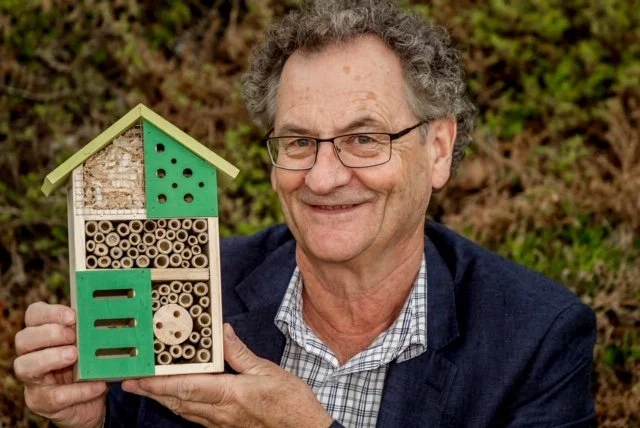
David Gill likes teaching people about the virtues of native bees and how to look after them.