Local fighter turns his sights on Port Phillip Bay
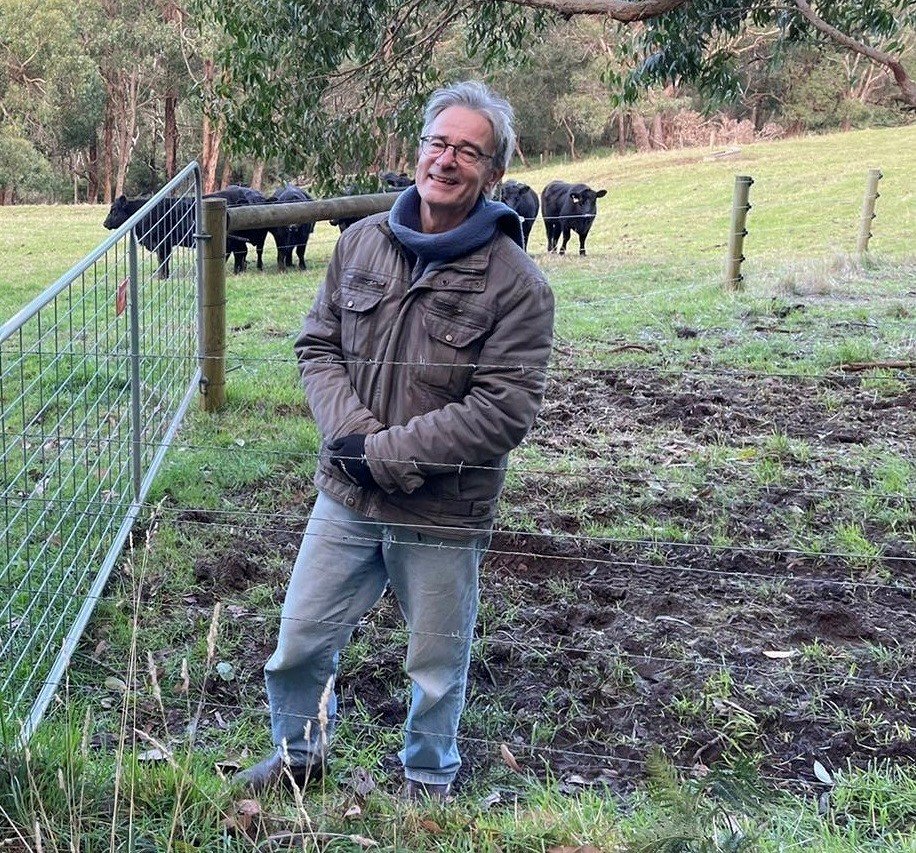
Shoreham CFA firefighter, Maarten Koster runs on adrenaline.
He might have retired from his day job as Asia Pacific President of the US technology company Novell, but Maarten certainly has not pulled up stumps.
The Shoreham CFA volunteer now puts his management and organisational training into fighting what he regards as environmentally damaging developments affecting the Mornington Peninsula.
“Most of my friends and I have children and grandchildren who will be left with the wreckage our generation is creating,” Maarten says.
About eight years ago, Maarten rallied Shoreham and Flinders locals in a fight against what he regarded as unnecessary and inappropriate development that involved an extensive native tree clearing and road building near his Black Angus cattle stud in Shoreham.
Then, through Environment Victoria, he got involved in the fight to prevent AGL from putting a floating storage and regasification unit (FSRU) at Crib Point in Westernport Bay, adjacent to an internationally recognised wetland.
“An FSRU is necessary to re-heat LNG liquid that, after being pumped out of the Victorian gas fields as a gas, was liquefied in order to ship it to buyers, most of them overseas,” Maarten says.
To be useable the company would need to regasify the LNG.
“The temperature of the seawater is transferred to the liquid through enormous heat exchangers, fed with huge amounts of seawater daily. To avoid marine life clogging the pumps and pipes, they inject large quantities of chlorine into the water to kill everything. Although chlorine dilutes and dissipates in seawater to an extent, large quantities are discharged into environment.”
Toxins are created when the chlorine discharge mixes with the bromine naturally occurring in seawater and then reacts with organic matter in the bay.
“They are known to create lasting DNA damage to marine life. In addition, some of these toxins are bio-accumulative: they enter and stay in the food chain,” Maarten says. “This means that not only will mobile marine predators spread the toxins across the bay, but they will also end up on our plates.”
In early 2021, the Victorian Labor government rejected the AGL proposal for the 300-metre-long floating gas terminal, claiming the environmental impact of the development would have been unacceptable.
If Maarten thought the battle was over, he was mistaken. It just moved across to Corio Bay.
In May 2025, the same government approved a proposal by Australian energy company, Viva Energy, to build a gas import terminal near Geelong and the Bellarine Peninsula Ramsar Site. In April 2026, it received Federal environmental approval.
Maarten is now fighting Netherlands-based tank storage company Vopak’s push to moor an LNG regasification unit at an existing anchorage in Port Phillip Bay, about 20 kilometres offshore from Avalon.
“It is only a couple of steps from getting approval to discharge 480 million litres of toxic chlorinated discharge a day into Port Phillip Bay, for a minimum of ten years,” he says.
In August 2021 the Victorian Planning Minister asked Vopak to prepare an Environment Effects Statement (EES) to assess the environmental, social and economic impacts of the company’s proposed project.
It also argued that its project would have low visual and community impacts, pose only a minimal disruption to the area, and provide up to 80 full-time jobs while in operation.
Maarten acknowledges that gas is part of our foreseeable future, but disputes talk of a crisis.
“There is ample gas in Australia and our use of it is dropping,” he says. “There would not be a shortage if gas reservation policies were in place here as they are in West Australia.
Earlier this year, Vopak presented its case for the proposed development to the Independent Advisory Committee (IAC) that the Victorian Government appointed.
In his presentation of the case against the Vopak proposal to the IAC, Maarten stressed the cumulative stress the discharge would place on the bay.
He also argued that the technology Vopak proposes using has been either banned or severely restricted in many countries in Europe under the OSPAR Convention for the Protection of the Marine environment of the North-East Atlantic.
“Europeans now know that ecosystems have a tipping point beyond which damage becomes widespread and, in many cases, irreversible,” Netherlands-born Maarten says. “We owe it to our children and grandchildren not to let this happen here.”
The IAC public hearings wrapped up at the end of August.
Maarten is now waiting for the IAC to publish its findings after which the proposal goes to the Victorian Planning Minister to consider.
In the meantime, Maarten has started a Change.org petition called Save Port Phillip Bay from Toxic Discharges and has already collected more than 8500 signatures. The link is https://c.org/dmRqxvvX6G